SiC Scanning Mirrors for Cutting, Welding, Marking & LIDAR
Push the Limits of High-Power Laser Processing
MERSEN optoSiC® mirrors deliver the highest combination of thermal and mechanical stability of any material which can be optically polished – engineered for the most demanding high-power laser processing applications in cutting, welding, marking, directed energy, and LIDAR.
Level up your Laser
Processing Performance
High-power laser material processing demands more from your optics than almost any other industrial application. Continuous-wave kilowatt beams, rapid scan cycles, and wavelengths spanning UV to CO₂ IR create thermal loads that glass and silicon mirrors cannot sustain – without drift, surface deformation, or coating failure that degrades beam quality and process yield.
optoSiC SiC scanning mirrors for laser processing eliminate these failure modes. The unique optoSiC+ material has the highest combination of thermal and mechanical stability of any material which can be optically polished. Because of this, your beam stays on target at full power, across every shift and every application.
leader in material and technology
Why SiC Scanning Mirrors for High-Power Laser Processing?
Silicon carbide is not a material science curiosity. It is the answer to a specific, high-stakes engineering problem: how do you steer a kilowatt laser beam with micron-level accuracy, at high scan speed, across thousands of production hours – without your mirror becoming the limiting factor?
Lightweight Design - Maximum Scan Speed
SiC's density is approximately one-third lower than conventional mirror substrates. Lower mass means lower moment of inertia. As a result, your galvo drive accelerates faster, throughput increases, and servo loads remain within spec even at multi-kHz scan rates. For high-end laser processes where cycle time is revenue, this matters.
Superior Thermal Management Under kW-Class Loads
Silicon carbide offers thermal conductivity of approximately "VALUE", far exceeding fused quartz (~1.4 W/m·K) and silicon (~150 W/m·K). Heat dissipates rapidly and uniformly. Therefore, dynamic flatness remains stable under sustained high-power illumination - no drift, no beam-quality degradation during long production runs.
High-Reflective Coatings - 99.5 %+ from UV to CO₂
Every optoSiC mirror ships with application-matched coatings. Reflectivity ≥ 99.5 % across wavelengths from 355 nm UV to 10.6 µm CO₂ minimises absorption and protects both the mirror substrate and your laser source. High-end quality for high-end applications.
Nature-Inspired Backside Rib Design
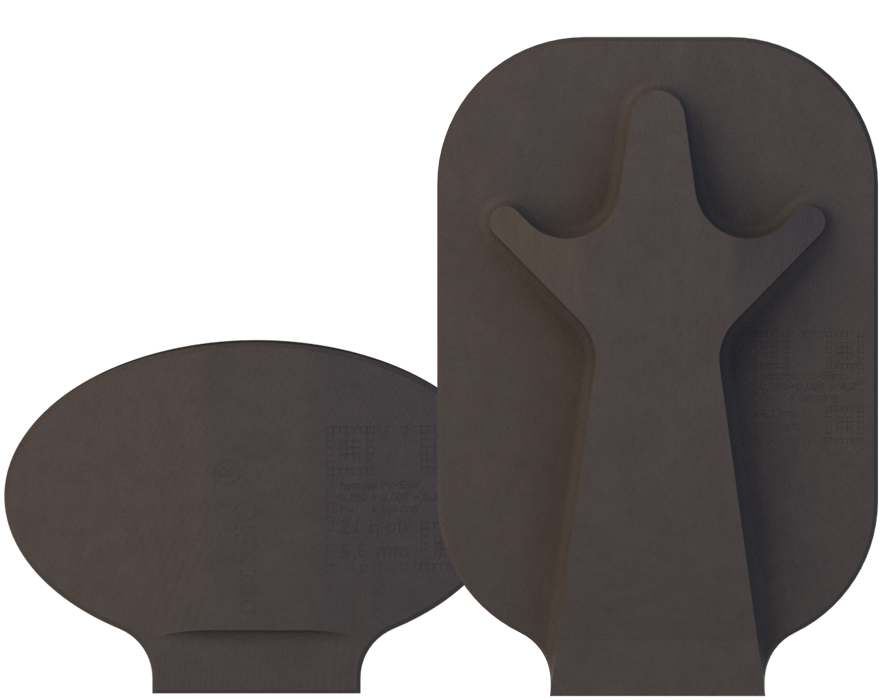
We found the technical solution for performance-optimized scanning mirrors in nature. Our backside rib design - inspired by the tree and leaf structure - combines maximum stiffness with minimum weight. High resonance frequency, low dynamic flatness error, and a mirror surface that stays geometrically stable when it matters most.
Application: Laser Cutting
Scanning Mirrors for High-Power Laser Cutting
Kilowatt cutting puts thermal load on optics that quartz and silicon cannot sustain. Dynamic flatness error climbs, the beam wanders, kerf width varies. optoSiC SiC galvo mirrors hold their geometry under continuous-wave output because silicon carbide dissipates heat fast – stable surface, no drift, consistent kerf from first part to last.
The backside rib design adds stiffness under the high torque of rapid contour changes. Your scan head tracks complex paths at full speed without ringing or overshoot.
Key performance factors - laser cutting:
- Low dynamic flatness error under sustained kW illumination
- Reflectivity ≥ 99.5 % at 1064 nm NIR
- Apertures XY20G through XY35G for standard industrial cutting geometries
Application: Laser Welding
Galvo Scanning Mirrors for Laser Welding
Remote welding, wobble welding, on-the-fly scan welding – all demand stable spot geometry under high power across long working distances. In EV battery manufacturing, a single optic-induced drift can affect thousands of cells before anyone catches it.
optoSiC SiC scanning mirrors reach stable operating temperature within seconds of power-on. No warm-up losses, no duty-cycle degradation – dimensional stability throughout the shift.
Key performance factors - laser welding:
- Stable surface geometry within seconds of power-on
- High stiffness-to-weight ratio for accurate spot placement at speed
- Apertures matched to your working distance and F-theta lens
Application: Laser Marking
Industrial Laser Marking Scanning Mirrors
Industrial marking – 24/7 production lines, UV wavelengths, tight resolution on demanding substrates – is a different problem from the budget galvo market. optoSiC SiC mirrors run UV-stable at 355 nm with coating durability built for continuous production load, not occasional use.
Low moment of inertia keeps marking speed high without sacrificing resolution. When your process runs multiple shifts without maintenance windows, your optics must not be the weak point.
Key performance factors - laser marking:
- UV-optimised coatings at 355 nm, reflectivity ≥ 99.5 %
- High resonance frequency for tight resolution at production speed
- Metal, ceramic, polymer substrate compatible at industrial power levels
Application: Directed Energy Systems
Fast Steering Mirrors for Directed Energy Systems
In ultra-high-power resonators and directed energy systems, even sub-microradian beam wander is unacceptable. optoSiC FSMs pair SiC’s thermal conductivity and dimensional stability with the tip-tilt actuation architecture that aerospace and defense integrators specify.
SiC also eliminates the occupational health constraints that beryllium handling imposes – a direct non-toxic substitute with equivalent dynamic performance for integration, maintenance, and end-of-life.
Key performance factors - directed energy:
- Non-toxic SiC substrate - beryllium substitute, equivalent dynamic performance
- Custom apertures up to VALUE mm for large-beam resonator applications
- Space-qualified heritage - NASA Psyche Mission FSM
Application: LIDAR and Sensing
Fast Steering Mirrors for LIDAR and Sensing
MEMS mirrors work for automotive near-field LIDAR at 1-7 mm aperture. Aerospace and long-range sensing require large apertures, space-qualified heritage, and thermal stability across temperature ranges automotive parts never see.
optoSiC FSMs serve this segment. Large aperture beyond the MEMS ceiling, tip-tilt actuation, and NASA Psyche Mission credentials – laser communication across nearly half a billion kilometres.
Key performance factors - LIDAR and sensing
- Large aperture - matched to long-range and aerospace sensing geometry
- Tip-tilt actuation with high resonance frequency
- Space-qualified SiC - NASA Psyche Mission heritage (2024)
Material Comparison:
SiC vs. Quartz, Silicon, and Beryllium
At kilowatt power levels, your choice of mirror substrate determines whether your process runs in specification or fails. However, most galvo mirror suppliers offer only quartz or silicon substrates – neither engineered for sustained high-power laser processing. optoSiC SiC scanning mirrors for laser processing fill this gap.
In addition to superior thermal performance, SiC eliminates the occupational health requirements that beryllium handling mandates under OSHA regulation – a decisive advantage for manufacturing, system integration, and maintenance environments.
Coating Performance
UV to CO₂ IR Comparison
optoSiC mirrors are available with application-matched coating stacks across the full range of industrial laser wavelengths. Reflectivity ≥ 99.5 % minimises absorption into the substrate, protects the laser source, and maximises energy delivery to your workpiece.
Custom coating stacks for other wavelengths or dual-band applications are available on request. Contact optoSiC with your wavelength, power density, and AOI requirements.
optoSiC Product Lineup
Our Mirrors for Laser Processing
optoSiC galvo scanning mirrors and fast steering mirrors span apertures from 10 mm to [TBD - nominally up to 500 mm], covering every laser processing application from high-speed UV marking to ultra-high-power resonator beam steering.
Standard galvo apertures are available from stock. Custom apertures and coating configurations are built to order – lead time on request. Contact optoSiC with your aperture, wavelength, power density, and scan-head configuration.
NASA-Proven Performance
Validated Across Nearly Half a Billion Kilometres
The ultimate test of an optic is not a laboratory bench. It is sustained operation under real-world conditions, with no opportunity for maintenance, recalibration, or replacement.
In 2024, NASA achieved a groundbreaking milestone in space exploration using optoSiC fast steering mirrors aboard the Psyche Mission spacecraft: laser communication maintained across nearly half a billion kilometres. No other SiC scanning mirror manufacturer carries this heritage.
As a result, when aerospace and defense systems integrators specify beam steering components for their most demanding programs, optoSiC is the reference point. However, the same material performance – high thermal conductivity, low dynamic flatness error, high resonance frequency – that qualifies our mirrors for interplanetary laser communication is equally available for your high-power industrial laser processing application.
Explore Related optoSiC Application Areas
Superior Optics for Accuracy and Speed
SiC scanning mirrors from optoSiC serve multiple laser-driven industries. If your application extends beyond laser material processing, explore our dedicated pillar pages:
Please ask us
Frequently Asked Questions
Silicon carbide’s thermal conductivity is approximately 100× higher than fused quartz. As a result, under sustained kilowatt illumination the mirror surface temperature stabilises rapidly and dynamic flatness error remains low – keeping your beam on the kerf without geometric drift. Quartz and silicon mirrors deform under the same load, introducing beam wander and kerf-width variation that increases scrap and reduces process yield.
Aperture selection depends on your working distance, F-theta lens configuration, and scan field size. For most industrial remote welding setups, the XY20G through XY35G range covers standard requirements. However, for long-standoff remote welding or large-format scan fields, larger apertures are available. Contact optoSiC with your system parameters to receive a specification recommendation.
SiC matches beryllium in thermal conductivity and specific stiffness for most laser processing regimes – without beryllium’s OSHA-regulated toxicity constraints. In addition, optoSiC+ silicon carbide can be polished to the same optical surface quality as beryllium, making it a direct, quantified, non-toxic substitute. Specific W/m·K and stiffness values: see the Material Comparison table above [fill TBD values before publish].
optoSiC coatings achieve ≥ 99.5 % reflectivity from 355 nm UV to 10.6 µm CO₂, with application-matched dielectric and metallic coating stacks. See the Coating Performance table above for wavelength-specific data. Dual-band and custom-wavelength coatings are available on request.
Standard galvo apertures are available from stock. Custom aperture and coating configurations are built to order – lead time provided on request based on your specification and current production queue. Contact optoSiC with your aperture, wavelength, power density, and delivery requirements to receive a quotation.
Any Questions?
Please get in touch.
We're always interested to answer your questions and listen to your Feedback!

Matthias
Struckmeyer
Managing Director
- info.munich@mersen.com
- +49 (0) 89 7807239-0
- +49 (0) 89 7807239-211